
02 · Nimrud & Nineveh, Mesopotamia (northern Iraq) · c. 900–600 BCE
Assyrian Palace Relief
Assyrian kings lined their palaces with carved stone panels taller than a person, telling the story of the empire in long bands that run around the room like a scroll. At every doorway stood a lamassu — a guardian with a bull's or lion's body, eagle wings, and a crowned human head, carved so that from the front it stands still and from the side it walks. Wedge-shaped cuneiform writing runs straight across the carving. It is storytelling at architectural scale.
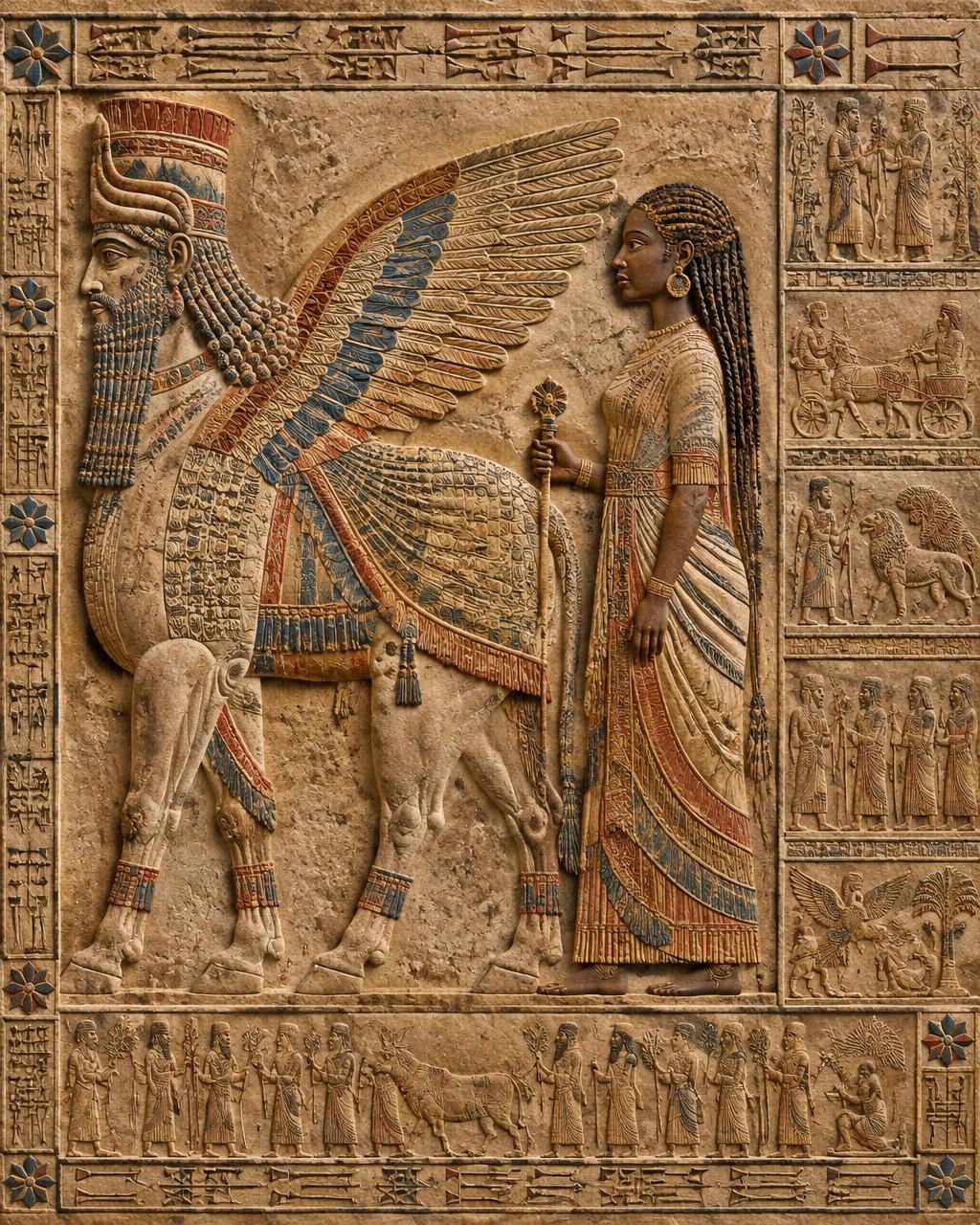
The royal Assyrian carvers
anonymous, 9th–7th c. BCE
Teams of stone carvers worked on gypsum alabaster panels already fixed to the palace walls, cutting shallow low relief with astonishing detail: every curl of a beard, every feather, every fringe on a robe. Stories were laid out in horizontal registers read left to right, and inscriptions were carved right over the figures. The panels were once painted, and traces of red, blue, and black still survive.
Look for
- winged guardian creatures
- low relief in pale stone
- horizontal narrative registers
- cuneiform text bands and borders
- tightly curled hair and fringed robes
You've walked the cycle for 02.
Now take that language into Studio Night. As the Style Curator in Act III, you can name this tradition and watch the whole class scene take it on.